


Movies Not Music in 2025
It was the movies not necessarily the music which had Americana fans enthralled in 2025. For two of the greatest singer-songwriters in modern music – Bob Dylan and Bruce Springsteen - had biopics delivered to cinematic audiences around the globe. But then again, the music wasn’t far away! Record companies for both superstars took the opportunity, as might be expected, to release compilation albums attuned, so to speak, to each film.
Dylan’s biopic A Complete Unknown was actually released on Christmas Day, 2024, but the worldwide distribution largely occurred in the new calendar year. The biopic was devoted to a specific period of his 60 year career – from his 1961 arrival in New York through to 1965. And in October, to stay in sync, Columbia and Legacy Records released the latest in his vast Bootleg Series – Bob Dylan’s Bootleg Series Volume 18: Through The Open Window. 1956-63 – and, as the title suggests, it covered much of the early period also canvassed in the movie.
Dylan’s collection was contained a Deluxe set of 8CD and 139 tracks which was an extraordinary mix of “never before released” recordings – including his very first in 1956 – and cuts categorized as “super rare.” Added to this were various tracks which cropped up in odd-ball, archival releases over the years. And a special feature was a previously unreleased recording – in its entirety – of Dylan’s landmark concert at Carnegie Hall on October 26, 1963, when on the verge of fame at age 22.
Springsteen actually upped the ante on October 24 this year, when both his biopic Deliver Me From Nowhere and accompanying album Nebraska ’82: Expanded Edition were released on the same day. The much-publicized movie was based on Warren Zanes’ book by the same title. It chronicled how Springsteen recorded the original Nebraska album – now considered a masterpiece – on a TEAC 144 four-track cassette recorder in the bedroom of a rented New Jersey house in January,1982, while suffering from severe depression.
And here the music probably upstages the movie. For the album includes tracks from the long-lost Nebraska tapes Springsteen actually recorded with his E Street Band. He had taken the cassette recordings into the studio, intending to use them only to jump-start the full electric treatment. But he was never satisfied with the E Street-sessions and decided to release only the sparse, acoustic original lo-fi “bedroom recordings.”
What made the whole episode so intriguing is that for years, Springsteen had denied that any archival material from the electric sessions ever existed. And he did so just a few months before the release of the Expanded Edition, telling Rolling Stone in mid-2025 that despite the rumours there was no tape: “I can tell you right now, it doesn’t exist.” Then, bizarrely, a month later he texted RS with this correction: “Just wanted to give you a heads up. I checked our vaults and there IS an electric Nebraska record, though it does not have the full album of songs.”
Like Dylan’s Bootleg Series 18, Springsteen’s Expanded Edition is a fascinating insight into the early development of a music legend. The documented, multi-disc set covered all bases of the evolution of Nebraska. There is the never-heard before outtakes and undiscovered recordings from the New Jersey cassette tapes. Then there is the much-denied electric versions – eight in all – with the E Street band. To top it off is an impressive live recording of the album Springsteen did in April, 2025, with minimalist acoustic accompaniment and no audience. All in all, a fine match for the movie.
But, surprisingly, the biopic itself failed to capture the hearts of both viewers and critics, certainly in comparison to A Complete Unknown. There was certainly a disparity in the box office returns. Deliver Me From Nowhere opened in 3,460 theatres, around six hundred more than the Dylan pic. Yet the box office returns for A Complete Unknown were $11.7 million for the opening weekend compared to Springsteen’s $9.1 million – probably helped by the Dylan pic being released in a holiday season. While lead actors, Timothee Chalamet (Dylan) and Jeremy Allen White (Springsteen), were both praised for their performances – Chalamet got an Oscar nomination and White is short-listed for a Golden Globe - the critical assessment of each movie was somewhat mixed. Critics thought A Complete Unknown failed to explore Dylan’s complexity, while Deliver Me From Nowhere was criticized for seemingly over-emphasizing Springsteen’s self-imposed depressive isolation.
There was a charming aftermath to the Dylan movie. And this centred on folk legend and activist Joan Baez who, as both a mentor and one-time girlfriend of Bob, was depicted prominently in James Mangold’s biopic. And, indeed, there was much praise for the actor, Monica Barbaro, who portrayed her.
For a little over a month after the movie’s release, Baez, 84, made a rare public performance – she retired from touring in 2019 – as guest of honour at a concert to celebrate 30 years of the Sweet Relief Musicians Fund, a charity she has supported for years. And to no surprise, one of the guests at the event was indeed Barbaro, whom Joan was happy to be pictured with backstage.
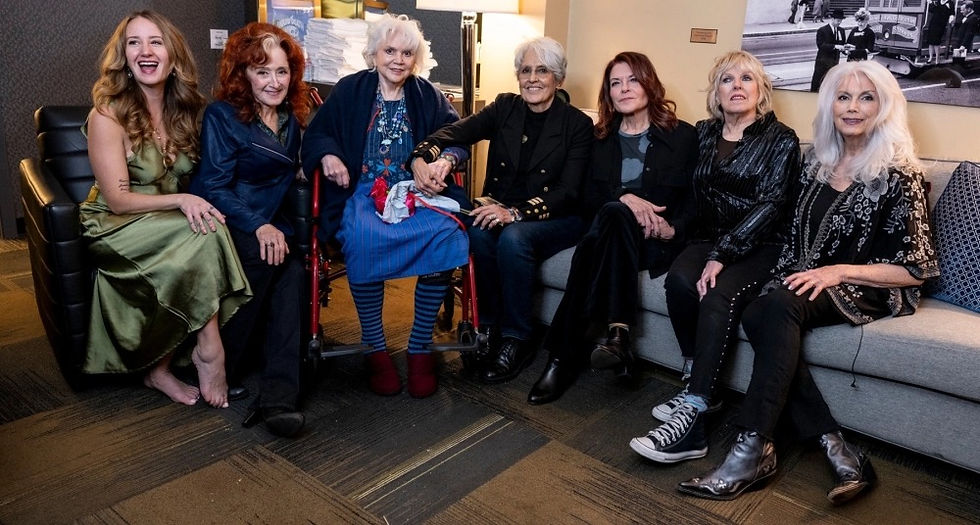
But it was another behind-the-scenes moment that produced what must rank as the Americana Photo of the Year. It features Baez flanked by six of the finest female singers in her mixed-musical genre – Emmylou Harris, Linda Ronstadt, Rosanne Cash, Lucinda Williams, Bonnie Raitt and Margo Price. The delightful photo attracted thousands of “likes” when Baez posted it on her Facebook page.
Baez, of course, wasn’t the only star venerated in 2025. As in any calendar year, the music industry is never shy in honouring artists and recognising achievements and anniversaries.
It was little surprise when one-time, street-corner busker Sierra Ferrell made a clean-sweep of all four Americana/Roots categories at the 67th Grammys in February. Her album Trail of Flowers topped four separate Billboard charts and was named the number one Best Country and Americana Album of 2024 by Rolling Stone. It won the Grammy for Best Album to go with her Grammys for Best American Roots Performance (“Lighthouse”), Best Americana Performance (“Americana Dreaming’) and Best American Roots Song (“American Dreaming”).
And Ferrell also cleaned up the Americana Music Awards, winning Artist of the Year for the second successive year.
But it was the Grammy won by Gillian Welch and David Rawlings for Best Folk Album which might have been the most popular among Americana fans - if not for purely sentimental reasons. For the popular duet’s 2024 album Woodland was named after their studio which, four years earlier, had been all but destroyed by a deadly tornado which swept through Nashville. And to no surprise, the album was recorded at the now-restored studio. It was the first album of songs written by Welch in 13 years and Rawlings’ first material since 2017.
Like Ferrell, Welch and Rawlings were also honoured at the Americana Awards, winning the Duo/Group of the Year.
Centenaries always top anniversaries in any given year. And in 2025 it was the venerable country music institution, the Grand Ole Opry, which celebrated 100 years. For it was November 28, 1925, that the first radio broadcast of the Grand Ole Opry show was broadcast. And it would help launch the legendary careers of the likes of Dolly Parton, Johnny Cash, Garth Brooks and Loretta Lynn.
The first sound ever heard at the Opry was a fiddle tune played by Uncle Jimmy Thompson. And a century later the very same instrument was used to open the first of several star-studded shows at the Ryman Auditorium, featuring more than 20 Opry members. And it was Ricky Skaggs - one of the greatest fiddlers of his generation – who played the same tune, “Tennessee Waggoner,” that 77-year-old Uncle Jimmy did all those years ago. “I’m excited to play it for the ending of the first 100 years of the Grand Ole Opry and the beginning of another 100 years,” Skaggs said.
It was actually the 50th anniversary of a maritime disaster which would impact the music charts during the past year. On November 10, 1975, the freighter SS Edmund Fitzgerald sank on Lake Superior with the loss of 29 lives. And the disaster prompted Canadian singer-songwriter Gordon Lightfoot to write “The Wreck of the Edmund Fitzgerald” – regarded as one of the finest ballads in music. When it was released in August 1976, the song reached number 2 in the U.S. Billboard Hot 100. And in 2025, history would be repeated when the disaster’s anniversary prompted a huge spike in both streaming and sales of Lightfoot’s haunting composition. The massive resurgence saw it hit number one on Billboard’s Rock Digital Song sales chart in the week ending November 20. Lightfoot died in 2023 at the age of 84.
And there would be a special 50th for one of the oldest-living mixed-genre music stars, 92-year-old Willie Nelson. For it is now 50 years since his ground-breaking album Red Headed Stranger was released. It was his 18th album but would prove to be the number one blockbuster which found him fame. And it also had a major impact on the music industry as it was seen as the first release which gave an artist total creative control. It would also give Nelson – as a singer - his first Billboard number one single “Blue Eyes Crying in the Rain.” The album itself would reach number one on the Billboard Top Country Albums and in 2000 was inducted into the Grammy Hall of Fame. To mark the 50th anniversary of the masterpiece, a special gold vinyl edition of Red Headed Stranger was released this year.
Nelson, of course, is still busy both performing and recording. He actually delivered two more solo studio albums in 2025 – taking his total to an astonishing 78. On April 25, he released Oh What a Beautiful World, featuring 12 tracks written by star singer-songwriter Rodney Crowell. It has been nominated for Best Traditional Country album at next year’s Grammy Awards. And on November 7, Willie released another tribute album Workin’ Man: Willie Sings Merle. And, yes, all the tracks were written by Willie’s old collaborator, the legendary Merle Haggard, who died in 2016. An endearing feature of the Merle album is that it includes the last released recordings featuring two of his original band members – pianist, and sister, Bobbie Nelson and drummer, and best friend, Paul English. It is thought the original tracks were laid down between 2016 and 2020. For English died in 2020 and Bobbie two years later.
It could be argued that no album better defines the much-debated Americana music genre than Emmylou Harris’s ground-breaking Wrecking Ball, released in 1995. And to mark its 30th anniversary, the Daniel Lanois-produced album was inducted into the Grammy Hall of Fame on May 16 in Los Angeles. Lanois would join Harris in performing during the induction ceremony when they were joined by drummer Brian Blade who was among the percussionists in the original recording sessions. “I don’t know if we knew what we were doing on that album, but Daniel Lanois gave me another 30 years of making the music that I love,” the 78-year-old Harris said at the ceremony.
Among those stars lost in 2025 were two artists who each made a major contribution to Americana’s ever-evolving genre in their own distinctive ways: Raul Malo, co-founder and lead vocalist for The Mavericks, and Todd Snider, an inventive singer-songwriter with a larger-than-life personality.
Malo, aged 60, died of cancer on December 8. He was born in Florida to Cuban parents and it was the Latin rhythms of South Florida which resulted in the unique multicultural influences The Mavericks injected into Americana music. But it was his golden voice – one of the best in the business – which really rubber-stamped the group, with hits like “What A Crying Same” and the now very-apt “All That Heaven Will Allow.”
Snider, 59, died around three weeks before Malo. Though his music seemed sometimes under-appreciated, he was recognized as one of the most compelling story-telling songwriters of his generation. His unique, iconoclastic lyrics surfaced in 1994 in his debut album Songs for the Daily Planet. And they were just as impactful ten years later when he released East Nashville Skyline – one of three albums for his friend John Prine’s Oh Boy label. The title was an obvious play on Bob Dylan’s Nashville Skyline and critics saw it as a serious attempt by Snider to define his home district on the east side of Nashville where alt-musicians were heading to escape the city’s mainstream country power base.
Sadly, the bizarre circumstances of his death on November 15 over-shadowed publicity of his musical accomplishments. Snider’s team released a statement saying he died from a case of “walking pneumonia that turned fatal.” But it is events in the two weeks preceding his death which have prompted questions about a series of complex incidents involving the singer-songwriter.
In late October Snider released his latest album High, Lonesome, and Then Some and was in Salt Lake City, Utah, on the second stop of a promotional tour. His show there was scheduled for November 1. But, some hours before, he was treated at a Salt Lake area hospital after claiming he had been seriously assaulted outside his hotel. The concert was cancelled at short-notice. Then, the next day, Snider, who had been open about drug addiction problems, turned up at another Salt Lake City medical facility, the Holy Cross Hospital, complaining of sharp pain and breathing issues. When medication was denied, he became angry and obstructive.
The police were called and he was arrested on suspicion of criminal trespass, threat of violence and disorderly conduct. Snider spent a night in police custody before being released. It was announced on November 3, that his tour had been cancelled. He returned to Nashville, where, some days later on July 8, he was admitted to hospital. He died on November 14.
If the year in Americana music was to start with film biographies, then it was to end in similar fashion. For in early December there was a cinematic farewell to John Prine – five years after his death – when the bio-documentary You Got Gold: A Celebration of John Prine debuted at a New York theatre. There will be a streaming release early in 2026.
Prine died from COVID-19 in April 2020 during the global pandemic. So fitting farewells to the Americana superstar were limited. It was not until October 2022 when fellow-musicians and fans got to say their formal goodbyes with two star-studded concerts at the Ryman Auditorium in Nashville. The film, directed by Michael John Warren, mixes these Ryman performances and backstage events with archival footage of the much-loved winner of a Grammy Lifetime Achievement Award. Among the big names to interpret his wonderful catalogue are Bonnie Raitt, the War and Treaty, David Isbell, and Gillian Welch and David Rawlings.
No doubt there is an affiliated album waiting in the wings.
Paul Cutler
Editor Crossroads – Americana Music Appreciation


Comments